
Age assurance is having a moment—because regulators, payment networks, platforms, and consumers all want the same thing at the same time:
- Keep minors out of adult-only spaces
- Reduce fraud and account abuse
- Respect privacy laws
- Avoid building a high-risk database of sensitive personal data
The problem is that not all “age verification” methods are equal. Some approaches are privacy-first by design. Others accidentally turn your registration flow into a data-security and legal nightmare.
Let’s break down three common approaches:
- Double-blind age verification
- Age estimation
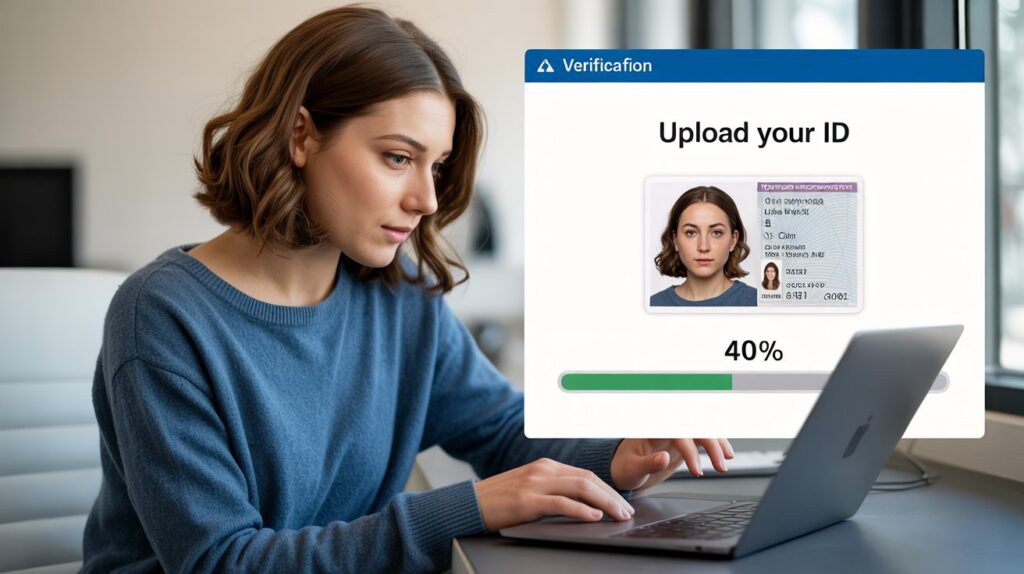
- Requesting an ID upload at registration
…and answer the big question: “Can’t I just ask users to upload their ID?”
What Is Double-Blind Age Verification?
Double-blind age verification is a privacy-preserving model where:
- Your website does not receive a user’s ID, date of birth, or document images.
- The verification provider does not learn what the user is doing on your site (or which site they’re verifying for), beyond what’s strictly necessary to complete verification.
- Your site receives a simple “yes/no” (and often a token): “Is this person above the required age threshold?”
Think of it like a bouncer at a door:
- The bouncer checks the ID.
- The venue only needs to know: can they enter or not—not their address, full name, or ID number.
This is powerful because it supports a best-practice privacy principle used across modern regulations: data minimization—collect only what you need, and nothing more.
Why it matters
If you’re not collecting IDs, you’re not storing IDs.
And if you’re not storing IDs, you’re dramatically reducing:
- breach exposure and liability
- compliance scope
- operational overhead
- user friction and abandonment
What Is Age Estimation?
Age estimation generally uses a camera-based selfie (or video) and machine learning to estimate whether a user is likely above (or below) a threshold—often returning something like:
- “Over 18 / under 18”
- “Over 21 / under 21”
- A confidence score
This method can be used in a few ways:
1) As a low-friction gate
If the user is estimated as clearly over the threshold, they pass quickly.
2) As a step-up method
If the estimate is uncertain, you can escalate to a stronger method (like document + selfie verification through a third party).
3) As an ongoing control
Some platforms use estimation to reduce repeat verification, enforce policies, or detect likely misuse.
The trade-off
Age estimation can reduce friction, but it introduces its own considerations:
- Accuracy and bias (especially across demographics)
- False rejects (blocking adults)
- False accepts (letting minors through)
- Biometric privacy implications depending on how data is processed and retained
This is where privacy-by-design and careful vendor selection matter: ideally, you want on-the-fly processing, minimal retention, and clear disclosures.
“Can’t I Just Ask Users to Upload Their ID at Registration?”
You can… but for most websites, it’s the highest-risk option with the worst user experience.
Here’s why.
1) You become the owner of extremely sensitive data
Government IDs contain far more than age:
- full legal name
- date of birth
- address
- ID number
- photo
- sometimes barcode / machine-readable zones
That’s a lot of high-value information to collect and protect. If you store it (even temporarily), you’ve dramatically increased your security responsibilities and breach impact, and you may have violated some laws.
2) Data minimization laws push you away from this approach
Across many privacy regimes, a core principle is:
only collect data that is necessary for the stated purpose.
To prove someone is “18+,” you typically do not need:
- their ID number
- their home address
- a full copy of their document
Better approaches verify age and return a result (or token) without transferring document images to the relying website.
3) It creates a breach liability magnet
If your registration database includes ID images, you’ve created a “must-attack” target. And depending on your users and location, breaches can trigger:
- mandatory notification obligations
- regulator scrutiny
- contractual issues with payment providers
- litigation risk
4) It increases friction and kills conversions
Asking users to upload their ID at registration introduces:
- hesitation (“Why do they need this?”)
- technical problems (file formats, camera access, lighting)
- abandonment (especially on mobile)
Even when users will verify, they often want a method that feels safer and more modern than sending an ID image to a website they just met.
5) You may accidentally collect data from minors
If a minor uploads an ID (or attempts to), you’ve now processed sensitive personal data tied to a minor—which raises the bar even higher in many jurisdictions.
Privacy and Age Assurance: How the Legal Landscape Shapes “Best Practice”
You’re not just building a feature—you’re building a compliance posture. While laws vary, many modern frameworks converge on the same ideas:
Data minimization and purpose limitation (widely recognized principles)
Across GDPR-style frameworks and similar privacy laws worldwide, regulators expect you to:
- collect only what you need
- use it only for the purpose you stated
- store it only as long as necessary
- secure it appropriately
ID-upload flows often struggle to justify collecting and storing full IDs when the goal is simply “confirm age.”
GDPR and the EU/EEA/UK privacy approach
In many European privacy contexts, document images and biometrics can be considered high-risk personal data, triggering:
- stronger consent and transparency expectations
- stricter retention policies
- vendor and processor contracts (DPAs)
- potential need for DPIAs (data protection impact assessments), especially with biometric processing
This doesn’t mean age verification is impossible in Europe—it means privacy-first methods are strongly favored because they reduce risk and scope.
United States: a patchwork that still points toward minimization
In the U.S., privacy is more state-driven, but trends are consistent:
- More states are adopting broad privacy laws (consumer rights + data minimization principles).
- Many laws treat data relating to minors, identity documents, and biometrics as more sensitive.
- If you operate nationally, you’re effectively navigating multiple state standards at once.
Again, ID uploads are often the most dangerous way to do something that can be done with less data.
Australia / Canada and other privacy regimes
Across many established privacy frameworks, the same themes show up:
- treat identity data carefully
- reduce collection where possible
- ensure strong vendor controls
- have a lawful basis and clear retention policies
The practical takeaway: the less you collect, the easier it is to stay compliant.
Choosing the Right Model: A Practical Summary
Double-blind verification is ideal when you want:
- strong assurance
- minimal PII exposure
- a clean “verified / not verified” result
- less breach risk and compliance scope
Age estimation is ideal when you want:
- speed and low friction
- step-up verification only when needed
- a lighter UX for returning users
- careful handling of biometric implications
ID upload at registration is usually the wrong default because:
- it creates the highest security and privacy risk
- it raises legal exposure
- it increases user drop-off
- it’s often more data than you truly need
- it is illegal in many jurisdictions
The Best Answer Is Usually: Verify Age, Not Identity
Most age-gated platforms don’t need to know who someone is.
They only need to know:
- Are they above the threshold (18+ / 21+)?
- Can the site rely on that result?
- Can it be proven later (without storing sensitive documents)?
That’s where privacy-first age verification shines.Is It Illegal to Require Users to Upload Their ID?
In certain jurisdictions, requiring users to upload their ID for age verification can be illegal or expose a website to serious legal risk, especially when less intrusive methods are available.
The key issue isn’t age verification itself—it’s over-collection of personal data.
Where ID Uploads Become a Legal Problem
🇪🇺 European Union / UK (GDPR & UK GDPR)
Under GDPR principles:
- Personal data must be necessary and proportionate
- Identity documents often contain excess data (address, ID number, photo)
- Collecting a full ID when only age confirmation is needed can violate data minimization
If a website requires users to upload their ID without a strong necessity justification or proper safeguards, regulators may view it as unlawful processing.
This is especially sensitive when:
- biometric data is extracted
- data is stored rather than immediately discarded
- minors attempt to upload ID
🇦🇺 Australia (Privacy Act & OAIC guidance)
Australian privacy law emphasizes:
- collecting only what is reasonably necessary
- avoiding high-risk identity data unless unavoidable
For many websites, forcing users to upload ID to confirm age may be seen as disproportionate, particularly when third-party or tokenized verification options exist.
🇨🇦 Canada (PIPEDA)
Canadian regulators apply a reasonable person test:
Would a reasonable person consider it appropriate to collect this data for this purpose?
For age-gating, collecting full ID images may fail that test—especially if safer alternatives exist.
🇺🇸 United States (State-Level Risk)
While the U.S. lacks a single federal privacy law, many states:
- treat ID documents and biometric data as sensitive personal information
- impose heightened duties around storage, disclosure, and breach notification
- apply stricter rules when minors are involved
In practice, ID upload flows often create liability exposure, even when not outright banned.
The Core Legal Problem: Proportionality
Across jurisdictions, regulators increasingly ask one question:
Did you collect more personal data than was necessary to achieve your goal?
If the answer is yes—and age could have been verified without storing an ID—the collection may be unlawful or indefensible.
This is why:
- double-blind age verification
- third-party verification with tokenized results
- privacy-first age estimation with step-up controls
are becoming preferred compliance strategies.
Why Privacy-First Age Verification Matters
Modern age assurance isn’t about collecting more data—it’s about collecting less.
Solutions like AgeWallet are designed to:
- verify age without exposing identity documents to websites
- reduce compliance scope and breach risk
- align with global privacy principles and emerging regulations
Learn more about AgeWallet’s privacy-first age verification and how it helps websites confirm age without collecting unnecessary personal data.